
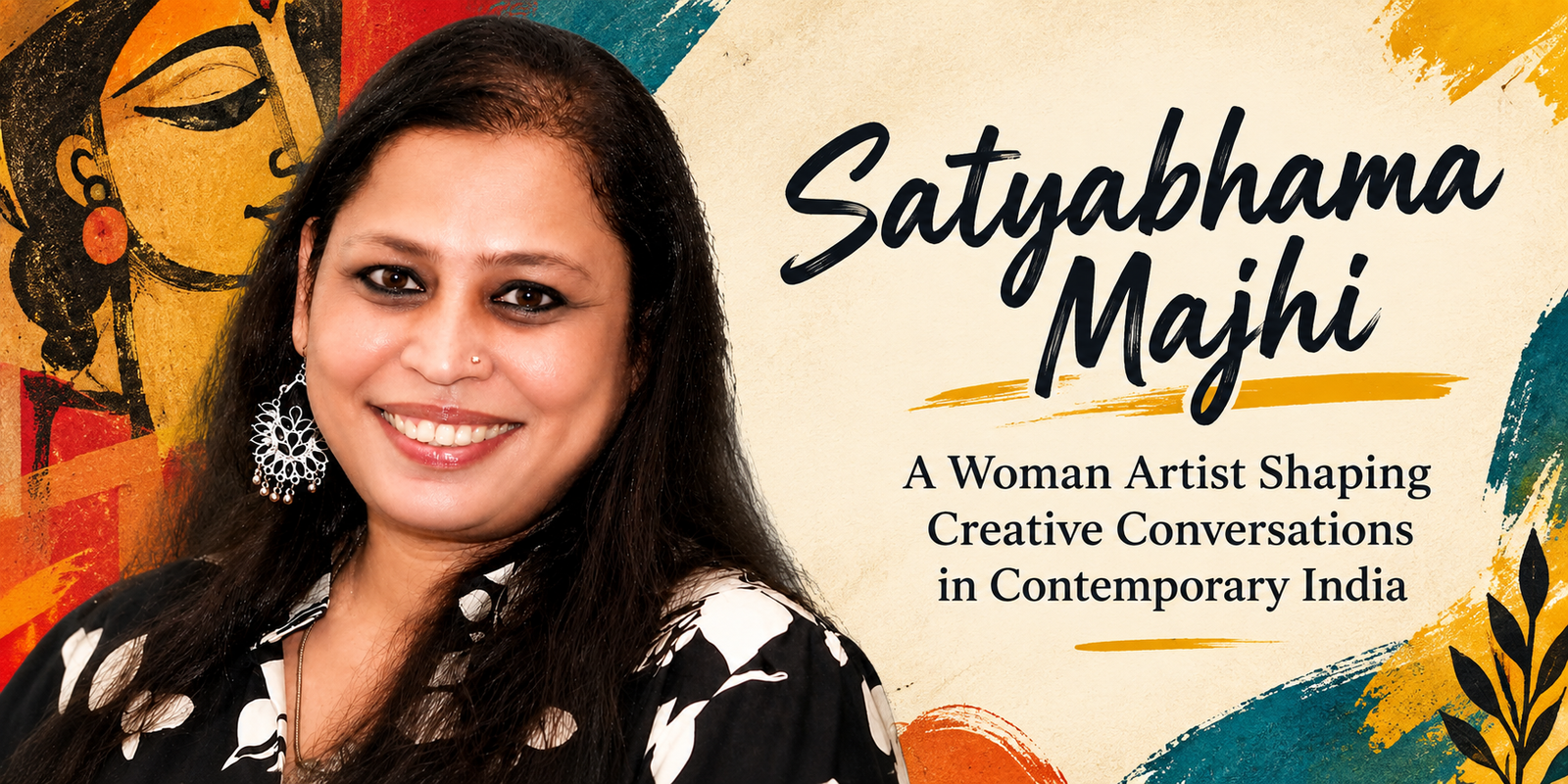
A contemporary artwork can communicate through more than recognizable subjects. Shapes, lines, patterns, repetition, colour, texture, and the arrangement of forms can create a visual language of their own. For Odisha-based artist Satyabhama Majhi, these elements contribute to an artistic vocabulary shaped by observation, landscape, cultural memory, everyday life, and community experience.
Working across painting, sculpture, installation, photography, mixed media, and public art, Majhi has developed a practice in which visual elements often carry meanings beyond their immediate appearance. A geometric form can recall a landscape. A repeated pattern can suggest movement or continuity. A natural pigment can connect an artwork with a particular environment. A large-scale mural can turn visual rhythm into a shared public experience.
Her practice demonstrates how contemporary art can build meaning gradually through the interaction of visual elements.
The Importance of Visual Language
Every artist develops ways of organising images and ideas.
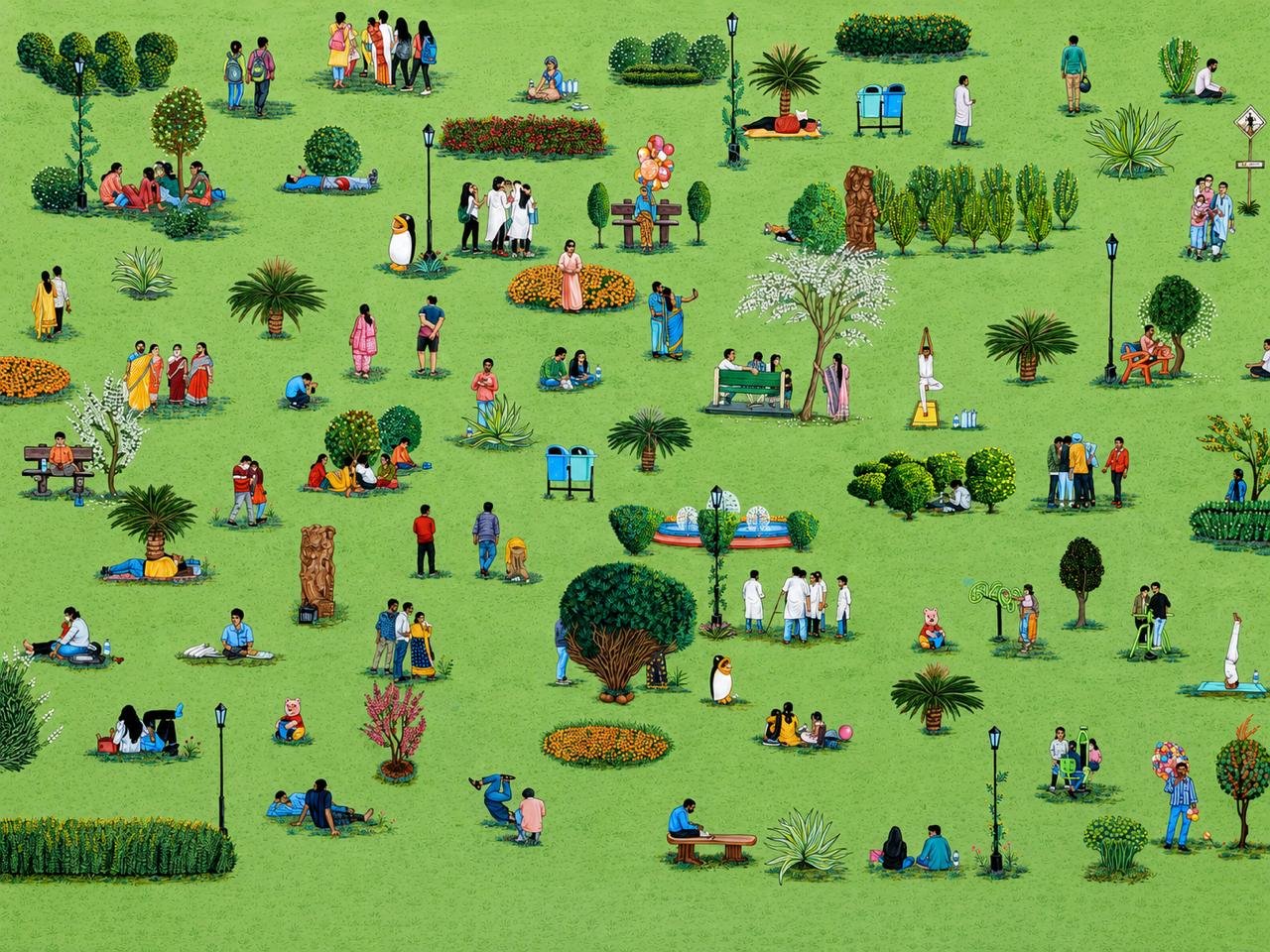
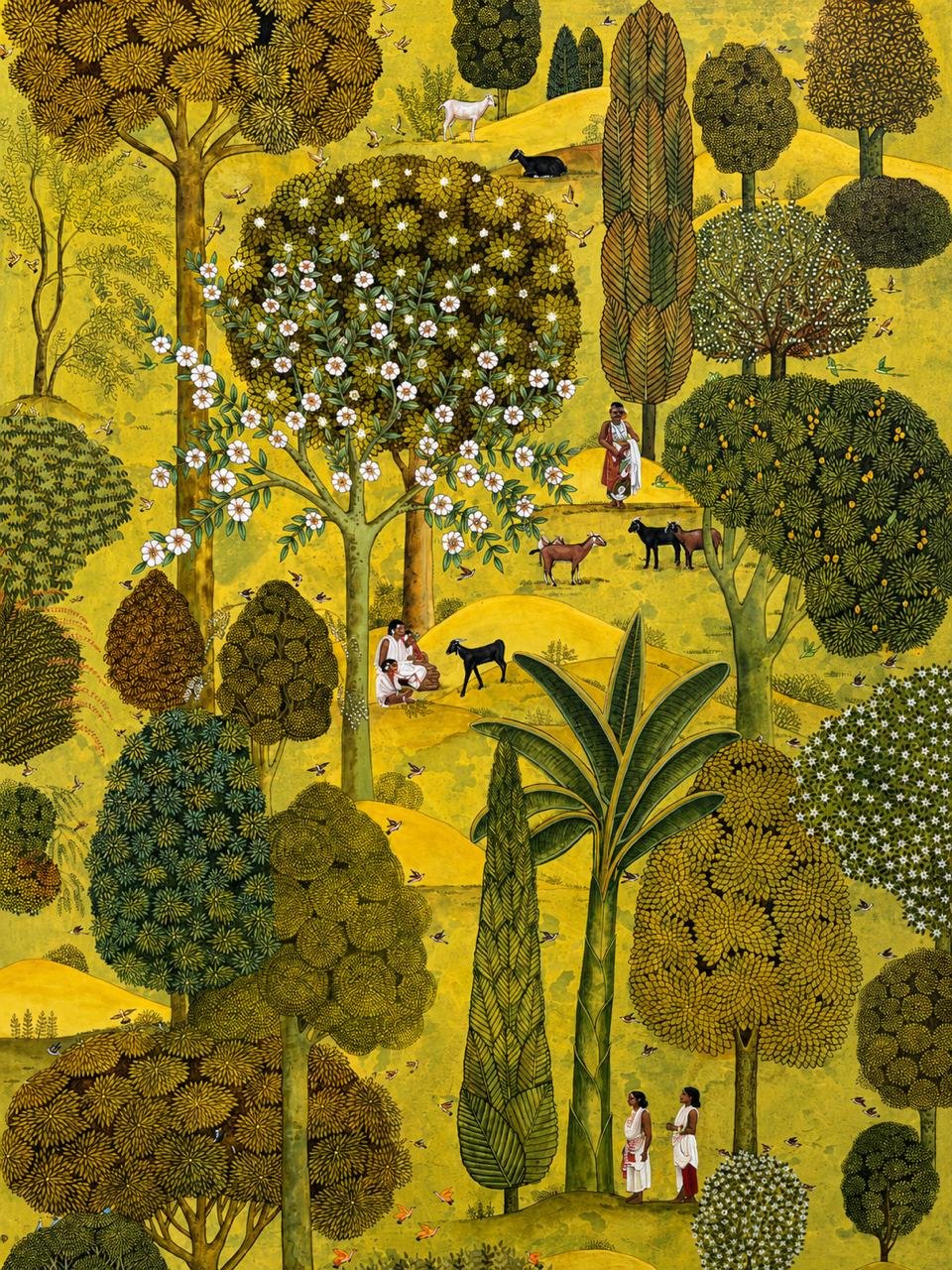
For Majhi, visual language emerges through the interaction of geometry, natural imagery, colour, material, repetition, and narrative elements.
Rather than depending entirely on literal representation, her work can invite viewers to consider relationships between forms.
This is particularly important in contemporary art, where an artwork may not provide a single straightforward interpretation.
Instead, meaning can develop through the viewer’s observation of shapes, textures, materials, and their relationship with the surrounding context.
Geometry as a Visual Tool
Geometry occupies an important place within Majhi’s artistic vocabulary.
Her recurring use of triangular forms is particularly significant. The triangle has connections with the landscape of Niyamgiri and the silhouette of its hills, while also carrying associations with stability, sacred geography, and cultural symbolism.
A simple geometric form can therefore connect several levels of meaning.
At one level, it can refer to the physical landscape. At another, it can become a symbolic element. Within a composition, it can also create balance, direction, repetition, or visual movement.
This flexibility allows geometry to function simultaneously as structure and meaning.
From Landscape to Abstraction
The transformation of landscape into geometric form is one of the interesting features of Majhi’s practice.
A mountain does not have to be represented as a realistic landscape painting.
Its essential shape can be reduced to a few lines or angles.
Through this process, the physical environment becomes part of an abstract visual vocabulary.
The Niyamgiri hills can therefore influence an artwork without requiring the artist to reproduce the entire landscape literally.
This movement from observation to abstraction allows place to remain present while the artwork develops its own visual identity.
Repetition and Rhythm
Repetition is another important principle in visual art.
Repeated forms can create rhythm in much the same way that repeated sounds create rhythm in music.
A shape appearing several times can guide the eye across a composition. Patterns can create movement, while variations within repetition can prevent the work from becoming static.
For an artist interested in community, landscape, and everyday movement, repetition can also carry conceptual associations.
Daily activities often involve repetition: travelling familiar routes, performing household tasks, working with materials, moving through landscapes, or participating in cultural practices.
Visual repetition can therefore echo the rhythms of everyday life.
Movement as an Artistic Idea
Movement is especially relevant to Majhi’s work inspired by Niyamgiri.
Her work Up and Down takes the physical movement associated with going uphill and downhill as an important point of reflection.
The movement is part of everyday life in the landscape, but it also becomes a metaphor for human experience.
Life involves continuous movement—between places, circumstances, challenges, and opportunities.
This idea demonstrates how an ordinary physical activity can become an artistic concept.
Movement can then be represented not only through figures but also through composition, direction, repetition, and visual rhythm.
Colour With a Sense of Place
Colour in Majhi’s practice is also connected with material and environment.
Her use of natural pigments includes materials such as chalk stone, charcoal, turmeric, geru soil, and brown stone.
These materials provide colours while simultaneously establishing a relationship between artwork and landscape.
The resulting colour is not simply selected from a commercial palette. It has a physical origin.
This connection gives colour another dimension.
It can communicate atmosphere and visual harmony while also carrying associations with the earth, local environments, traditional knowledge, and cultural memory.
Texture and Material Presence
Material contributes significantly to how an artwork is experienced.
Natural pigments can produce different visual and tactile qualities from manufactured colours. Similarly, sculpture and installation allow viewers to encounter material through physical space rather than only through a two-dimensional surface.
Majhi’s multidisciplinary practice gives her opportunities to explore these differences.
The material can become part of the narrative.
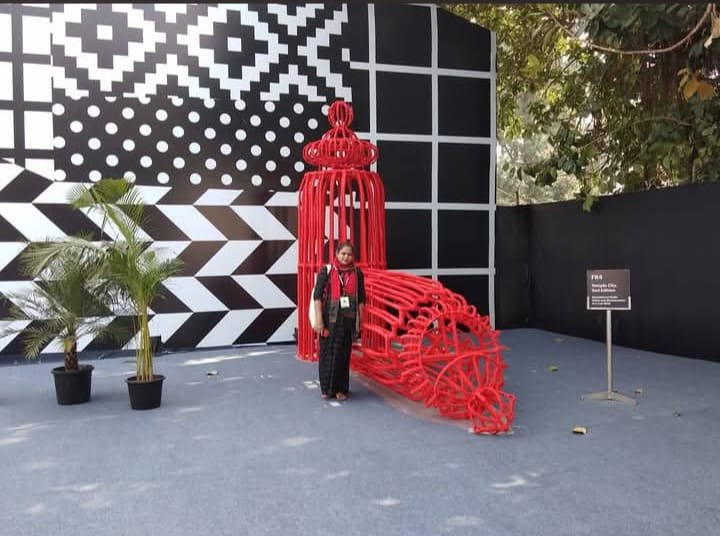
A substance associated with the earth can evoke landscape. A wall can connect an artwork with a neighbourhood. A three-dimensional object can alter the viewer’s physical relationship with space.
In this way, material is not simply a technical component of art.
It can become part of its meaning.
Everyday Life and Visual Narrative
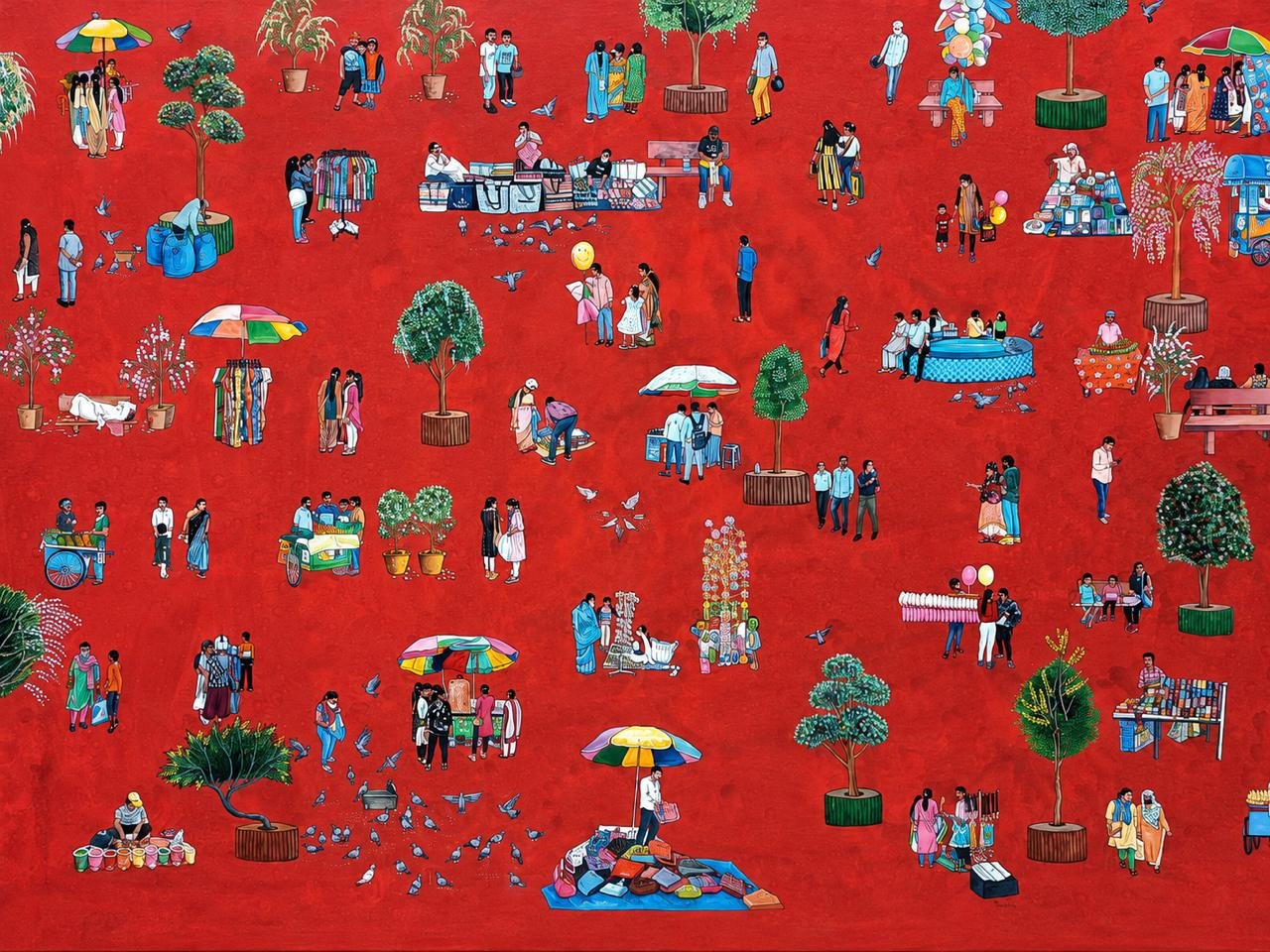
Majhi’s interest in everyday life adds a narrative dimension to her compositions.
Ordinary experiences can provide subjects that are familiar but not necessarily simple.
A marketplace, a neighbourhood, a household activity, a journey, a festival, or an encounter with nature can contain multiple layers of memory.
By focusing attention on such experiences, the artist gives visual significance to aspects of life that may otherwise pass unnoticed.
This approach also connects with her work in art education, where children are encouraged to observe their own surroundings and transform personal experiences into creative expression.
The Relationship Between Pattern and Memory
Patterns can preserve cultural memory.
Traditional visual practices often use recurring forms, arrangements, and motifs that are passed from one generation to another.
Majhi’s engagement with traditional art and indigenous visual culture has contributed to her understanding of how visual elements can carry cultural associations.
When such forms enter contemporary art, their meanings can expand.
A traditional visual reference can be placed within a new composition, combined with contemporary techniques, or interpreted through a different medium.
The pattern therefore becomes a link between memory and experimentation.
Public Art and Large-Scale Rhythm
The principles of composition become especially visible when an artist works on a large scale.
Majhi’s involvement in public murals and artistic interventions in Odisha has required visual ideas to function across substantial architectural surfaces.
At this scale, individual shapes become part of a larger rhythm.
The viewer may not see the entire artwork at once. Instead, different sections can be encountered while walking, travelling, or moving through a public environment.
This creates a different kind of visual experience from looking at a painting in a gallery.
The artwork becomes something that unfolds through space.
Walls as Visual Narratives
A public wall can function almost like a large visual page.
Different elements can interact to create a narrative without relying on written language.
Majhi’s public-art activities in Cuttack and Bhubaneswar, along with murals connected with sporting and cultural events, demonstrate the possibilities of this approach.
The wall can incorporate visual references to community, place, movement, nature, or cultural identity.
Because the work exists in a shared environment, its audience is also diverse.
Community Experience and Visual Structure
Majhi’s community-based practice adds another dimension to the idea of visual structure.
When an artist engages with a community, the resulting work can be informed by many experiences rather than one individual viewpoint.
Her sustained engagement with the Dongaria Kondh community has introduced her to visual traditions, cultural practices, livelihood patterns, and relationships with nature.
These experiences can influence the forms and materials through which ideas are expressed.
The visual composition consequently becomes connected with lived experience.
The National Scale of Collective Visual Expression
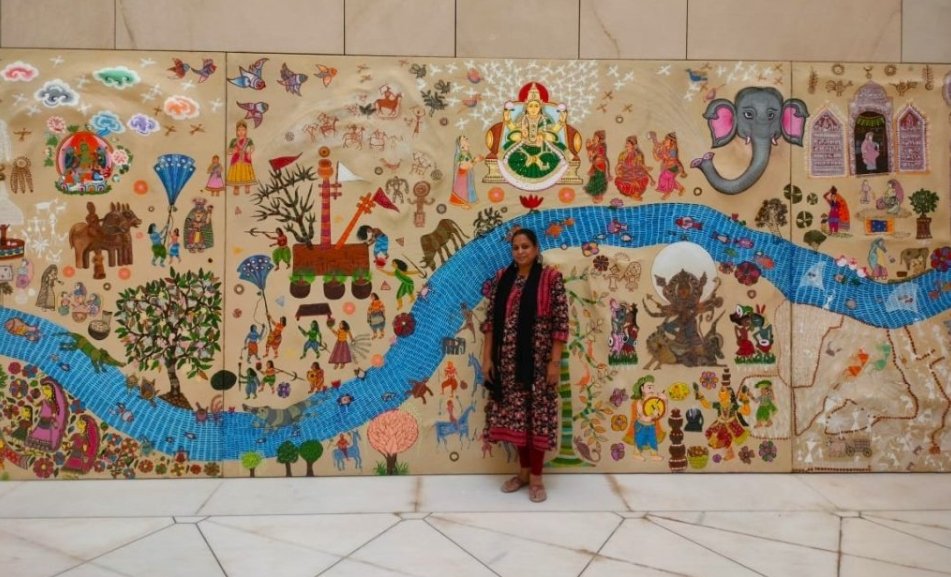
The 2023 project People’s Wall – Jan, Janani and Janmabhumi offers another example of visual diversity operating at a large cultural scale.
Created for the New Parliament House through the Lalit Kala Akademi, New Delhi, the project involved women artists and artisans from different regions of India.
Majhi served as a Co-Sutradhar and creative contributor.
The collaborative nature of the project meant that different regional artistic languages could contribute to a larger visual composition.
It demonstrated how diversity itself can become an organising principle in art.
Balancing Repetition and Variation
An effective visual language often depends on the balance between repetition and change.
If every element is identical, the composition may become predictable. If every element is completely different, visual coherence can become difficult to establish.
Recurring forms provide continuity, while variations create movement and interest.
Majhi’s multidisciplinary practice allows her to explore this balance in different ways.
The same broad concerns—people, place, ecology, memory, tradition, and community—can appear repeatedly while taking different visual forms.
A Language That Continues to Develop
One of the strengths of Majhi’s artistic journey is that her visual language remains open to development.
Her practice has expanded from painting into sculpture, installation, photography, mixed media, public art, community engagement, and education.
Each new context creates opportunities to reconsider form and composition.
The fundamental questions remain connected to people and places, but the methods of expression can change.
This flexibility allows her work to remain contemporary without losing its connection with regional experience.
Conclusion
Satyabhama Majhi’s art demonstrates how visual meaning can be constructed through geometry, repetition, rhythm, colour, material, movement, and context.
The triangle can recall the hills of Niyamgiri. Natural pigments can establish a relationship with the earth. Repeated forms can evoke movement and continuity. Public murals can transform these principles into large-scale visual experiences.
Her interest in everyday life and community experience adds another layer, connecting formal artistic decisions with lived realities.
Across painting, sculpture, installation, photography, mixed media, and public art, Majhi continues to develop a visual vocabulary in which form and meaning are closely connected.
Her work suggests that contemporary visual storytelling does not always require a literal image or a written explanation. Sometimes meaning emerges from the relationship between shapes, materials, memories, landscapes, and people.
In this way, Satyabhama Majhi’s practice demonstrates the continuing power of visual language: a language capable of carrying memory, place, movement, cultural knowledge, and human experience through form itself.